
In distributed systems, workloads often arrive in unpredictable bursts that can overwhelm downstream services. The Queue-based Load Leveling pattern uses message queues as buffers to smooth out these bursts, ensuring consistent performance and preventing service overload while maintaining system responsiveness.
This pattern is essential for handling variable workloads in cloud applications, where traffic spikes can cause performance degradation or service failures. By implementing intelligent queuing mechanisms, you can create more resilient and predictable systems.

This guide walks you through the Queue-based Load Leveling pattern from concept to practical implementation, covering sample producer and consumer implementations, with best practices and production deployment considerations.
Understanding the Queue-based Load Leveling Pattern
The Queue-based Load Leveling pattern introduces a queue between service producers and consumers to buffer requests and smooth out workload variations. This creates a more predictable processing pattern and prevents downstream services from being overwhelmed.
Core Architecture
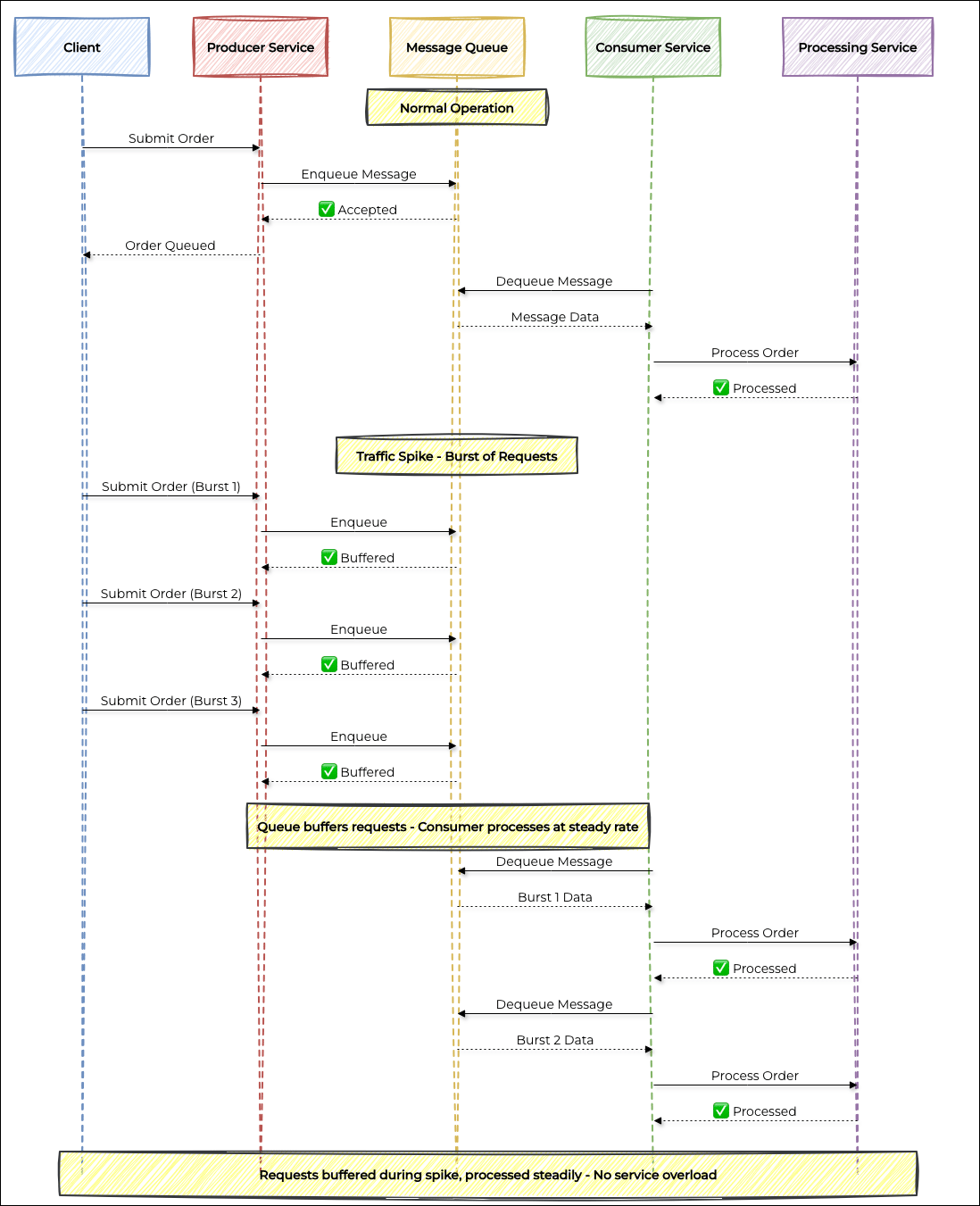
Queue Based Leveling Pattern Interactions
Key Benefits
Load Smoothing: Converts variable workloads into consistent processing patterns.
Service Protection: Prevents downstream services from being overwhelmed.
Scalability: Enables independent scaling of producers and consumers.
Resilience: Provides buffering during service outages or slowdowns.
Backpressure Management: Controls the rate of processing based on consumer capacity.
Implementing the Queue-based Load Leveling Pattern
Let's build a queue-based load leveling system that demonstrates the core pattern with producers, consumers, and proper message handling.
Implementation Overview
LoadLevelingQueue: Core bounded queue with capacity limits and basic tracking
MessageProducer: Enqueues messages with retry support for handling full queues
MessageConsumer: Processes messages from the queue with configurable threading
Order Processing Example: Practical demonstration of the pattern
Note on Implementation
This implementation uses Java's BlockingQueue for thread-safe message handling. For production systems, consider using dedicated message brokers like RabbitMQ, Apache Kafka, or cloud services like AWS SQS for durability, persistence, and distributed scaling.
Core Queue Implementation
public class LoadLevelingQueue<T> {
    private final BlockingQueue<T> queue;
    private final String name;
    private final AtomicLong totalMessages = new AtomicLong(0);
    private final AtomicLong rejectedMessages = new AtomicLong(0);

    public LoadLevelingQueue(String name, int capacity) {
        this.name = name;
        this.queue = new ArrayBlockingQueue<>(capacity);
    }

    public boolean enqueue(T message) {
        boolean success = queue.offer(message);
        if (success) {
            totalMessages.incrementAndGet();
        } else {
            rejectedMessages.incrementAndGet();
        }
        return success;
    }

    public T dequeue(long timeout, TimeUnit unit) throws InterruptedException {
        return queue.poll(timeout, unit);
    }

    // Monitoring methods
    public int getCurrentSize() { return queue.size(); }
    public int getRemainingCapacity() { return queue.remainingCapacity(); }
    public long getTotalMessages() { return totalMessages.get(); }
    public long getRejectedMessages() { return rejectedMessages.get(); }
}
Message Producer Implementation
public class MessageProducer<T> {
    private final LoadLevelingQueue<T> queue;

    public MessageProducer(LoadLevelingQueue<T> queue) {
        this.queue = queue;
    }

    public boolean produce(T message) {
        return queue.enqueue(message);
    }

    public boolean produceWithRetry(T message, int maxRetries, long retryDelayMs) {
        for (int attempt = 0; attempt < maxRetries; attempt++) {
            if (produce(message)) {
                return true;
            }

            if (attempt < maxRetries - 1) {
                try {
                    Thread.sleep(retryDelayMs);
                } catch (InterruptedException e) {
                    Thread.currentThread().interrupt();
                    return false;
                }
            }
        }

        // All retries failed - send to dead letter queue or alert
        System.err.println("Failed to enqueue message after " + maxRetries + " retries");
        return false;
    }
}
Message Consumer Implementation
public class MessageConsumer<T> {
    private final LoadLevelingQueue<T> queue;
    private final Function<T, Boolean> messageProcessor;
    private final ExecutorService executorService;
    private final AtomicBoolean running = new AtomicBoolean(false);

    public MessageConsumer(String name, LoadLevelingQueue<T> queue, Function<T, Boolean> processor) {
        this.queue = queue;
        this.messageProcessor = processor;
        this.executorService = Executors.newSingleThreadExecutor(r -> {
            Thread t = new Thread(r, name + "-consumer");
            t.setDaemon(false);
            return t;
        });
    }

    public void start() {
        if (running.compareAndSet(false, true)) {
            executorService.submit(this::consumeMessages);
        }
    }

    public void stop() {
        running.set(false);
        executorService.shutdown();
        try {
            if (!executorService.awaitTermination(60, TimeUnit.SECONDS)) {
                executorService.shutdownNow();
            }
        } catch (InterruptedException e) {
            executorService.shutdownNow();
            Thread.currentThread().interrupt();
        }
    }

    private void consumeMessages() {
        while (running.get()) {
            try {
                T message = queue.dequeue(1, TimeUnit.SECONDS);
                if (message != null) {
                    messageProcessor.apply(message);
                }
            } catch (InterruptedException e) {
                Thread.currentThread().interrupt();
                break;
            } catch (Exception e) {
                System.err.println("Error processing message: " + e.getMessage());
            }
        }
    }
}
Practical Example: Order Processing System
public class OrderProcessingSystem {
    private final LoadLevelingQueue<Order> orderQueue;
    private final MessageProducer<Order> orderProducer;
    private final List<MessageConsumer<Order>> orderConsumers;

    public OrderProcessingSystem(int queueCapacity, int consumerCount) {
        this.orderQueue = new LoadLevelingQueue<>("order-queue", queueCapacity);
        this.orderProducer = new MessageProducer<>(orderQueue);
        this.orderConsumers = new ArrayList<>();

        for (int i = 0; i < consumerCount; i++) {
            MessageConsumer<Order> consumer = new MessageConsumer<>(
                "order-consumer-" + i,
                orderQueue,
                this::processOrder
            );
            orderConsumers.add(consumer);
        }
    }

    public void start() {
        for (MessageConsumer<Order> consumer : orderConsumers) {
            consumer.start();
        }
    }

    public void stop() {
        for (MessageConsumer<Order> consumer : orderConsumers) {
            consumer.stop();
        }
    }

    public boolean submitOrder(Order order) {
        return orderProducer.produce(order);
    }

    private boolean processOrder(Order order) {
        try {
            // Simulate order processing (100-300ms)
            Thread.sleep(100 + (long)(Math.random() * 200));
            System.out.println("Processed order " + order.getId() + " for customer " + order.getCustomerId());
            return true;
        } catch (Exception e) {
            System.err.println("Failed to process order: " + e.getMessage());
            return false;
        }
    }
}

// Supporting classes
record Order(String id, String customerId, double totalAmount) {}
Putting It All Together
public class Main {
    public static void main(String[] args) throws InterruptedException {
        // Create system with queue capacity of 100 and 3 consumers
        OrderProcessingSystem system = new OrderProcessingSystem(100, 3);
        system.start();

        // Simulate variable workload - 50 orders arriving quickly
        System.out.println("Submitting 50 orders in burst...");
        for (int i = 1; i <= 50; i++) {
            boolean accepted = system.submitOrder(new Order("ORDER-" + i, "CUST-" + i, 99.99));
            System.out.println("Order " + i + " submitted: " + (accepted ? "accepted" : "rejected"));
        }

        // Let consumers process
        Thread.sleep(5000);
        system.stop();
    }
}
Example Output
Submitting 50 orders in burst...
Order 1 submitted: accepted
Order 2 submitted: accepted
...
Order 50 submitted: accepted
Processed order ORDER-1 for customer CUST-1
Processed order ORDER-2 for customer CUST-2
Processed order ORDER-3 for customer CUST-3
Processed order ORDER-5 for customer CUST-5
Processed order ORDER-4 for customer CUST-4
...
When to Use Queue-based Load Leveling Pattern
Understanding when to apply the Queue-based Load Leveling pattern is crucial for making the right architectural decisions. Here's when it shines and when alternatives might be better:
✅ Ideal Scenarios:
Your system experiences unpredictable traffic spikes that overwhelm downstream services.
You need to decouple producers from consumers for independent scaling.
You want to protect backend services from being overwhelmed during peak loads.
You need to maintain system responsiveness even when processing capacity is limited.
You're building event-driven architectures with variable workloads.
You want to absorb temporary failures by buffering requests until services recover.
❌ Skip It When:
Your workloads are consistent and predictable with no spikes.
Real-time processing is required with zero latency tolerance.
Message ordering is critical and cannot be compromised.
The added complexity of queue management outweighs the benefits.
Your system has sufficient capacity to handle peak loads directly.
You need synchronous request-response patterns (use Circuit Breaker instead).
Best Practices
Size Your Queue Appropriately: Balance memory usage against buffering needs. Too small causes message rejection during spikes; too large wastes resources and increases latency.
Implement Dead Letter Queues: Handle messages that repeatedly fail processing. Don't lose critical data—route failed messages to a separate queue for investigation.
Monitor Queue Depth: Track queue size as a key health indicator. Growing queues signal that consumers can't keep up with producers—a capacity planning signal.
Use Backpressure Signals: When queues fill up, signal producers to slow down rather than silently dropping messages. Return meaningful errors to callers.
Plan for Consumer Scaling: Design consumers to scale horizontally based on queue depth. Consider auto-scaling rules that add consumers when queue depth exceeds thresholds.
Handle Message Ordering: If ordering matters, use partitioned queues or single consumers per partition. Parallel consumers can process messages out of order.
Found this helpful? Share it with a colleague who's struggling with variable workloads in their distributed systems. Got questions? We'd love to hear from you at [email protected]